Message from the ADA President

Fighting for dental insurance fairness, clinical autonomy

Listening and delivering value to ADA members

Dear Colleagues,

The ADA belongs to us — its members — and every day across the country dedicated volunteer leaders and our professional team are working hard on your behalf to help you succeed and to advance the health of the public. That’s the ADA’s mission.

I was installed as your president six months ago. No single president in a single term can solve everything — meaningful progress takes time — but in case you’re wondering if the ADA is really making an impact for you, our profession and the public’s health, the answer is a resounding YES, and it would not be possible without your membership.

As I travel the country and listen to volunteer leaders and members alike, one of the biggest pain points shared with me is dental insurance. Here’s what ADA is doing about it:

Protecting clinical autonomy. Let’s start here because as doctors nothing should come between the doctor-patient relationship. There should be no interference with our clinical autonomy when it comes to diagnosing and providing treatment recommendations to our patients. Our ADA Council on Ethics, Bylaws and Judicial Affairs published this white paper on clinical autonomy (PDF) to make our position clear.

Fighting for fairness. We all know that dental plans are not “insurance” compared to medical insurance. Annual patient maximums have not changed for decades, and reimbursement rates have not kept pace with the rate of inflation despite the rising cost of all goods and services. I’m as frustrated as the members I’ve heard from about dental insurance “coverage” and reimbursements that make it difficult for patients to afford necessary major procedures…reimbursements that can also make it difficult to pay dental team members and practice overhead costs, particularly for small, dentist-owned practices that do not have high volume purchasing power for supplies and are not able to spread costs across an entire chain of dental clinics.

So, what is the ADA doing to help balance the scales and achieve fairness for providers and patients alike? These are the dental insurance reform (DIR) issues we are advocating for supercharged by the ADA’s State Public Affairs (SPA) program — funded through your membership dues dollars — that provides grant funding to state dental societies for state-based advocacy. Learn more about all of the ADA’s dental insurance reform efforts at ADA.org/DIR:

Putting power back in the hands of dentists and patients

  • Network Leasing: Protecting dentists from being pawned off to different insurance networks without knowledge or consent.
  • Virtual Credit Cards: Giving dentists a say in how they get reimbursed for care. Watch this two minute video from me about a victory in model state legislation.
  • Assignment of Benefits: Allowing patients to request their insurer pay their dentist directly for care.
  • Retroactive Denials: Limiting insurers’ ability to demand repayment of previously-paid claims.
  • Prior Authorization Payments: Ensuring that insurers make good on their promise to cover care.
  • Non-covered Services: Prohibits insurers from dictating the cost of care they aren’t covering.
  • Dental Loss Ratio: Requiring that the majority of patient premiums be spent on patient care.
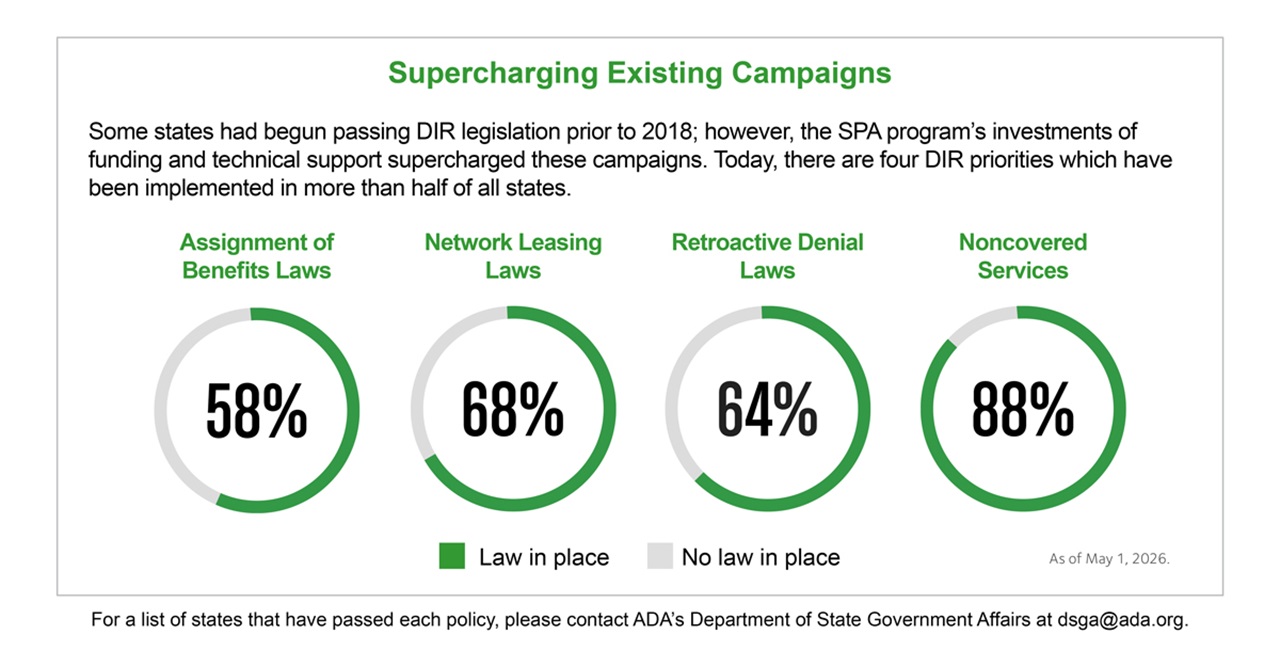
Supercharging Existing Campaigns

Nationally, the ADA is advocating for the following and provides free resources for members:

  • Requesting Action by the Federal Trade Commission (FTC) Healthcare Task Force. In a detailed letter (PDF) sent April 29, ADA Executive Director Dr. Nader Nadershahi and I expressed concern to the Task Force and requested five action items for its consideration. We noted that “many dental insurance markets exhibit substantial concentration, with limited meaningful competition on provider contracting, reimbursement, transparency and benefit design. The Competitive Health Insurance Reform Act of 2020 clarified that federal antitrust laws apply to the business of dental insurance and that this change should be followed by active oversight and enforcement where facts warrant. Recent GAO analysis, conducted at the ADA’s urging, reinforces these concerns, finding that the combined market share of the three largest stand-alone dental insurers in the group market ranged from 38% to 97% across states, and reached 80% or more in 11 states.”
  • Sounding the alarm on dental insurance companies buying dental practices. The ADA is raising awareness, including that of the Federal Trade Commission and the Department of Justice, about dental insurance companies purchasing dental practices. From a business standpoint, dental insurance companies seek to minimize cost and maximize profit. As a result, patients may find their treatment options limited to what is most cost-effective for the insurer, not necessarily what is most effective for their oral health.
  • ERISA reform and IDA Act. The Employee Retirement Income Security Act of 1974 (ERISA) regulates self-funded dental plans. Some carriers argue it allows them to ignore state insurance laws meant to protect patients. The ADA, with a coalition of other national dental associations, led the way in the development of the Improving Dental Administration (IDA) Act of 2026 introduced to Congress by Representative Jeff Van Drew and Representative Herb Conaway. State laws governing issues such as noncovered services, network leasing, prior authorization, prompt payment, and retroactive denials exist to protect the doctor-patient relationship and to curb anti-competitive practices. The IDA Act would allow these laws to apply uniformly to both fully insured and self-funded dental plans and would help close the ERISA loophole where some patients and providers are protected by state law, while many others are not.
  • Third-Party payer concierge. Offered free of charge to ADA members only, the third-party payer concierge service answers dental insurance questions or concerns. Available 8:30 a.m. to 5:00 p.m. Central Time Monday through Friday at dentalbenefits@ada.org or 800.621.8099.
  • Contract analysis service. Offered free of charge to ADA members who submit requests through their state dental society, the contract analysis service helps you understand dental insurance provider contract terms in clear language before you sign them so you can make informed decisions about the implications of participation and avoid unpleasant surprises in the future. Before you sign a provider contract, the ADA’s contract analysis service is here to help. For more information, contact your state dental society.
  • Other resources. Visit ADA.org to learn about CDT resources, improving insurance claims success, on-demand webinars, helpful articles, and downloadable guides for common dental insurance issues. Register here for the webinar “Navigating Contracts, Coverage, and Care with ADA experts” to be held June 15 from 5–6 p.m. central time. Webinar topics include exclusivity clauses in PPO agreements, PPO leasing arrangements, and reimbursement and lack of dental plan assistance for out of network dentists. CE credit is not provided.

Your membership enables all this and so much more. Unified in voice. Unified in purpose. This is your ADA. Thank you for your membership!


Dr. Richard Rosato, President