






You can also listen on the ADA Member App and enjoy bonus content.
It’s the money roadmap you need now to help you build long-term financial security.
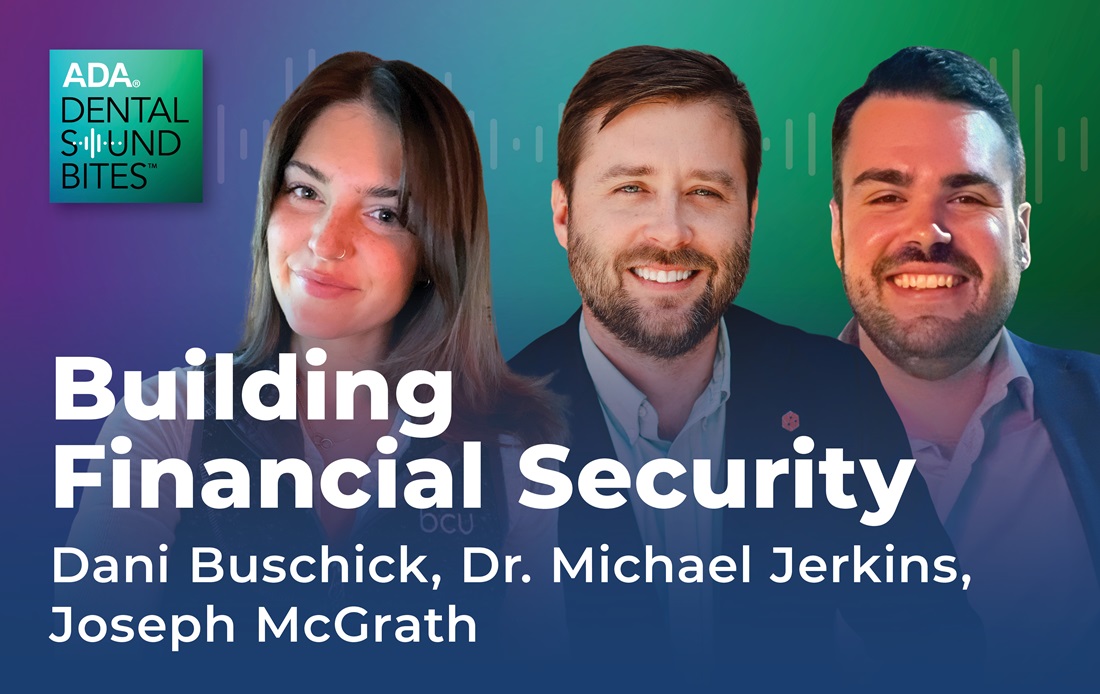
Building Financial Security
Description: It’s the money roadmap you need now to help you build long-term financial security. We’re sharing five money moves you can make today, what you need to know before switching career paths, and the one student loan deadline that you can’t afford to miss.
Featured Guests:
“I know I have these student loans. What do I need to do with it? So, I kind of wish that I had like that next step. And I think that, the content that we're going to be sharing and talking about in this episode will really help you take that next step.” — Dr. Arnelle Wright

Joseph McGrath


Show Notes
Resources
Disclosures
[00:00:00] Ioannidou: Get ready people because this is a “cannot miss” episode. It's really important, so pay attention. We are sharing with you the money roadmap you need to help you build financial security. So, hi everybody, I'm Dr. Effie Ioannidou.
[00:00:15] Wright: Hello. Hello, and I'm Dr. ArNelle Wright. And in this episode, you all, we are sharing five money moves that you can make right now, what you should know before switching between these two career paths.
And there's one key date that you can't afford to miss if you have student loans. So, if you are listening to this episode or watching it on YouTube, you're gonna want to take notes. Let's go.
[00:00:41] Announcer: From the American Dental Association, this is Dental Sound Bites created for dentists by dentists. Ready? Let's dive right into real talk on dentistry's daily wins and sticky situations.
[00:00:57] Ioannidou: Hello, friends. This episode is packed with practical time sensitive information, so you do not want to miss a single minute of it.
[00:01:07] Wright: Yes. Such good financial information. We've got lots to talk about, and I want to dive right in.
[00:01:15] Ioannidou: Let's start with our journey towards building financial security with a closer look at the student loans and what borrowers need to know right now.
You all know that. You know, obviously I have been in academia for a very long time, even before some of our listeners were born. Darn it. So.
[00:01:38] Wright: That means you have experience. That's not always a bad thing.
[00:01:41] Ioannidou: I'm seasoned.
[00:01:42] Wright: You're seasoned.
[00:01:43] Ioannidou: Look. Seasoned, but I'm seasoned. Yeah, seasoned. So, so I've seen a lot of students, I've seen a lot of residents graduating, starting their careers and really have a lot of stress and worrying about their future.
Yeah.
It's difficult to tackle. There is too much information. Um, and honestly, it's something we do not touch upon during dental school years.
[00:02:07] Wright: Yeah, it's very, very true. I will say, when I was going through dental school, which was like at the time that we're recording this almost nine years ago, yesterday, you know, just a little bit ago.
Still trying to be cute.
[00:02:19] Ioannidou: Yeah.
[00:02:19] Wright: But, um, we had like the, we, we were at the end of our senior year, we got this book and we got this snapshot of our financial picture, which was good, if you had, like the right people in your life, maybe in your family, on your money team is what I call it now. Um, but for me, I was like, okay, I got this.
Yeah, I know I have these student loans. What do I need to do with it? So, I kind of wish that I had like that next step. And I think that, you know, the content that we're gonna be sharing and talking about in this episode will really help you take that next step. Um, I'm definitely still worried about student loans.
Things are changing. I'm now a practice owner, so that's a completely different story, like a, a bigger burden on top of me of course. And so, um, I'm glad that we get to have this conversation for our listeners because not only is it gonna help me, but then it gives us more talking points and, and greater perspective.
It gives us information to share if you will.
[00:03:21] Ioannidou: Yeah. I completely agree with you. And I think that the other, say different, uh, we, we can, we offer, uh, you know, two different perspectives, right? We offer, uh, uh, your perspective ArNelle, that you are an American trained, newly practicing dentist.
[00:03:37] Wright: Youthful.
[00:03:38] Ioannidou: And a youthful and recent owner.
So, one perspective, right? And then mm-hmm. You have my perspective, a foreign trained dentist, right? Uh, coming from a very different educational system with, as I mentioned, many times with zero loans.
[00:03:54] Wright: Mm-hmm.
[00:03:55] Ioannidou: So, I think it's important, big difference to big, huge difference. And I think it's important to offer these two perspectives and, and see how we can make, uh, sense of it for our students, for our residents, for our practicing dentists and for our academic dentists.
Right.
[00:04:11] Wright: Yeah. Oh, gosh. I love that we get to like, bring everybody together on like a topic. That is really impactful to everyone that's gonna be listening in.
[00:04:21] Ioannidou: Yeah, absolutely.
[00:04:21] Wright: And things are changing a lot right now, so to make sense of everything that we need to know, we asked our friend Joseph McGrath at Key Bank to give us the details.
Let's take a listen.
[00:04:33] McGrath: Thank you so much for having me on. Uh, just to introduce myself, everyone. My name is Joseph McGrath. I'm a partner relationship manager over here at Key Bank. Key talking points today are to give everyone a breakdown as to some of the changes in the student loan landscape that have come into effect over the course of the last year.
Um, a lot of dentists who are typically enrolled in a lot of the, uh, repayment options, I'm going to cover, uh, have a lot of changes that they need to be prepared for. And basically, my goal overall here is to give everyone some good information as it pertains to what these changes are gonna be, any potential action items that you need to do right now, uh, and how to just best prepare yourself for a lot of the incoming changes that are coming down the pike over the course of the next few months.
So first and foremost, I want to give everyone a date to circle in their calendar, and that's July 1st, 2026. So, July 1st, 2026, is when a lot of these changes that I'm going to cover are going into effect. I'll go through them, uh, one by one, but I want to start with first the SAVE program. So, I'm sure a lot of people listening to this, uh, may have been automatically enrolled in the SAVE program, uh, for anyone that doesn't know, the SAVE program is a version of what, uh, the umbrella term is called Income Driven Repayment (IDR). Income Driven Repayment, for anyone that doesn't know, is a very popular option amongst dentists. It is a repayment option where individuals dedicate a certain percentage of their after-tax income towards their student loans over the course of 20 years with the expectation being that there will be some forgiveness at the end of those 20 years. Typically, the idea is the cap that you will pay is at 10%. Now there are many different versions of income driven repayments under that umbrella. There's income-based repayment (IDR), income contingent repayment (ICRD), pay as you earn, and finally, the SAVE program. The SAVE program is, more or less, the focal point of a lot of these changes that you've seen, uh, announced over the course of the last few months. So, for anyone that doesn't know, the SAVE program is on the way of being phased out. So actually, March 10th, 2026, it has been closed and what the path forward is for individuals who are in the SAVE program is on July 1st, 2026, that magical date that I'm gonna mention many more times over the course of this, uh, of this talk. Uh, individuals who are in the SAVE program will have the option to enroll for up to 90 days after July 1st, 2026, into a different version of IDR. Basically, what's happening right now is that one when the One Big Beautiful Bill was signed that really restructured the way income driven repayment works, and they're phasing out a number of different programs.
First one being the SAVE program, and then after that, rolling out a new program. So, for individuals that are in the SAVE program, you can enroll in income-based repayment as it stands right now or wait until July 1st. And then on July 1st, you can either enroll in a new program called the RAP plan, or you can enroll in income contingent repayment, or pay as you earn.
Now, the differences between those are rather complicated. That's why we're gonna urge people who want to have a look at their student loans to utilize the consultation that Key Bank offers to ADA members. Uh, the link is in the, uh, description to the episode below. But basically, what's happening is they are shifting a lot of these programs over to kind of simplify the federal student loan landscape.
So, one is the SAVE program, like we just mentioned. Now, there are people who are listening to this episode that might not necessarily be in the SAVE program. They can be in income contingent repayment, pay as you were. Those two programs, while still available, will be available until 2028. Uh, on July 1st, 2028, those two programs will be phased out.
So, you do have a little bit of a longer roadmap. If you're in those two programs, you can wait it out. Uh, we do wish to look into your options a little bit more soon than that. We don't want anyone to be in a situation where your monthly payments won't count towards it. Eventual forgiveness now, we don't know anything for sure there yet, and things can always change.
A lot of things can always change if we learned anything over the past year in the student loan landscape. Um, and then finally, for income-based repayment itself, income-based repayment is a program that is available right now and will be available up until July 1st, 2026. So, if you're looking to get into income-based repayment or you're already in income-based repayment, uh, you should either enroll in it before July 1st, 2026, or you, if you're in it now, you can stay in it. On July 1st, 2026, at that point forward, you will no longer to be able to enroll in income-based repayment. And in effect, the only two repayment options that you'll have available to you, and by extension, the only two federal repayment options that will be available to all borrowers is the new RAP plan, as well as a revised version of an existing plan called the Standard Repayment Plan.
So, the RAP plan will be a new version of income driven repayment where, again, much like the others, you dedicate, uh, a certain percentage of your after-tax income towards your student loans. What that percentage is entirely dependent on what your student loan balance is, but you'll never pay more than 10% of your after-tax income towards your student loans. That's an important takeaway.
Uh, and then the standard repayment plan is a plan that does exist right now. However, they are changing it a little bit and creating more of a tiered structure in terms of how you pay that loan off. So, the standard repayment plan is a program where you're gonna pay off the entirety of your student loan balance. Now, how it exists right now is you'll pay that loan off in either 10 years or 20 years, depending on what your balance is, and they're expanding that out a little bit, uh, further. Uh, again, depending on what your balance is, you could pay it off in 10 years, 15 years, 20 years, or 25 years, depending on what your balance is.
But again, what, where you lie on that is entirely dependent on what your loan breakdown is or even if you're willing to pursue that program. So, um, another important piece of the discussion is public service loan forgiveness. Now, I know a lot of dentists, uh, don't necessarily pursue public service loan forgiveness because it's contingent on your employer.
But a good breakdown if people think it might be available to them is public service loan forgiveness is an offshoot of income driven repayment. And it's available to individuals who work in 501C3 nonprofits, public health systems, law enforcement, government, military. And that is a program where you choose one of the four IDR programs, but it effectively cuts the time in half.
Income driven repayment by itself is a 20-year repayment program, whereas public service loan forgiveness is 10 years. Um, another important takeaway is that if you achieve forgiveness on income driven repayment by itself, that forgiveness that you get is considered taxable income. So that's something that you will need to prepare for.
Uh, there is a payment that needs to be made at the end, whereas with public service loan forgiveness, once you've satisfied that 10-year requirement, it's forgiven completely tax free. One last point before I move on to the private side of student loans. For anyone that's in residency right now, one, uh, important piece of information that a lot of, uh, people who are in residency do not know is that programs like income driven repayment, and public service loan forgiveness, are available while you are in residency. And actually, it's a really great option for individuals to have a very low required monthly payment on their student loans while they go through residency and actually knock off a few years towards that eventual forgiveness where they didn't have to pay a lot out of pocket.
A lot of people wait until they're practicing to enroll in these programs, and then they're starting with a, you know, much higher monthly student loan payment. Whereas if you take advantage of it early, you can have a few years where it's very, very low. In fact, a lot of residents, year one, might even have a $0 monthly payment requirement for their student loans, not pay a dime that entire year, and have that eventually count towards their forgiveness.
[00:12:02] Wright: Wow. A lot of good information. It was a lot of information, but it was good.
[00:12:08] Ioannidou: Yeah. Did you give notes?
[00:12:09] Wright: I was taking some notes over here. I don't even know if y'all could see that, but I was taking my notes.
[00:12:14] Ioannidou: I'll test you.
[00:12:17] Wright: Listen, not only was I over here taking notes like a mad woman, you know what else I did really quickly, and sorry to the producers, but I had to just go into my dashboard of my student loan services to be like, well, which one of the, the payment plans am my on?
[00:12:32] Ioannidou: That's right. You know, I needed to know all of this. I love this. That's, yeah, in real time, real life. This is real life. A real time impact, absolutely. So, share a little bit of your experience with student loans, uh, ArNelle. Like, uh, how, you know, what, how do you think this, uh, changes will impact you or if, if they will?
And, and what was your experience with the past, uh, few years that you're practicing?
[00:12:56] Wright: Mm-hmm. So, you know what? I've always been on the income driven repayment plan, and I just had to double check, but I don't think I'm enrolled in any of these, like the RAP, the pay as you earn the uh, ICRD. I think that's a different version of IDR, but I know I'm on income driven repayment plan, right?
[00:13:14] Ioannidou: Yeah.
[00:13:14] Wright: So. I've always paid whatever, like I do my taxes, I submit it, and then I just pay whatever they, they tell me to pay, which is, I probably should pay attention to this a little bit better. And the reason why I bring that up is now I'm pretty much forced, not only because of, you know, legislation and how they're revising everything, but I'm a practice owner now.
So, um, my income has changed significantly, and like my tax status has changed. So that's gonna impact like, how my payments are made, um, you know, I guess for the rest of my life or as long as I'm in business, let's just say that.
[00:13:51] Ioannidou: Yeah.
[00:13:51] Wright: The other thing that I was gonna say is, what I like about this conversation is I've never had this breakdown of all of the options, and I know that it's all new because like these things are happening in real time since you know the Big Beautiful Bill was signed and now it's impacting student loans directly and federal loans and, and all of us that are in, you know, the medical or health professions altogether. So, this was a really good breakdown and like, I was over here taking notes because I'm like, these are some of the conversations that I need to go back and have with, you know, the people who are helping me financially.
Um, like my, I need to talk about this, not with my lender, but with my bookkeeper, my accountant, um, my tax attorney to just make sure that all of these T's are crossed and i's are dotted for me now that I've transitioned from being an associate to a practice owner. Yeah, so AKA like right now from, I don't know if this is too much information, but I'm just gonna share it because we're already here.
I'm not paying myself like a W2, so all of that, that. Once I start paying myself on a W2, or if I decide, depending on what's gonna be the best strategy for me to yield financial success on the business side and personal side, then it's gonna change for me again. You know what I mean? Yeah. So, I'll be going through these conversations again.
I don't know, it's probably way too much information, but I think the listeners can benefit.
[00:15:11] Ioannidou: Yeah. The listeners can benefit. And I find, you know, as, again, as someone that, uh, has never had the student loans, uh, or any other loans training or in residency...
[00:15:21] Wright: So jealous.
[00:15:22] Ioannidou: Yeah. It's a very complicated system.
It's not easy to navigate, you know? Uh, in, in, in other, um, areas of the world, uh, usually those, uh, loans are, uh, subsidized by the government and there is no, it's 0%, uh, uh, uh, interest rate, and they make students' life, uh, easy to, to pay back to afford and pay back. So, I find that this, perhaps this industry is an industry for profit here.
I mean, not perhaps, we know profit.
Yeah. Right. Not but delete it perhaps.
[00:15:58] Wright: Sorry, that laugh.
[00:15:59] Ioannidou: So, so, and, and, uh, as you said that, you know, it's, it's a burden for us students for sure. And, and it's so hard to, to, you know, recover and, and make the decision to become an owner like you, you did, right?
[00:16:15] Wright: You know, and I'm like, okay. I'm, uh, I will tell you full disclosure. There are some days where I'm just like, okay, hmm, now was this a good idea in the times that we're in? But I feel like we've been through hard times, like economically and, and, and although like I wasn't an owner at that time. Like, I've seen people's stories and like they come out on the other side.
So, what I'm trying to do is just make sure that I do everything that I can, you know, that's within my power and I don't just sit back passively, you know what I mean? Yeah. So now that I am an owner, it, I have like an extra fire like lit under me. I feel like I have like a natural fire under me altogether, but now that I'm the owner, it's a different kind of fire.
So, um. Part of the reason why I was over here taking notes like a crazy woman is because I want to make sure that I have all of this, you know, um, information so that I can share it. Um, and when I'm talking to new students or early career, like graduates, one of the first things that I ask them about is, are you familiar with what's happening with student loans legislatively?
Like I, that's right. I bring that up. And there's some, I was at a, um, I was doing some dental work, um, for free at this free clinic, like here in town. And, um, there was a volunteer who just got into dental school, and I was like, have you heard about the federal loan caps? And she was like, yeah. And I was like, okay.
As long as you know, stay engaged.
Yeah.
Keep your ear to the ground because of this.
[00:17:43] Ioannidou: That's a huge issue.
[00:17:43] Wright: Yeah. So, I'm like, I don't have all the answers, but you need to be engaged in it.
[00:17:47] Ioannidou: Yeah, for sure. And I think we can touch upon this a little bit later, but maybe we can, uh, also, uh, see if Joe, uh, our partner, uh, can, offer some, uh, um, clarifications related to, uh, refinancing versus consolidating loans.
Right?
[00:18:06] Wright: Yes, yes, please.
[00:18:07] Ioannidou: You know, or if we call it the mortgage of your dental education? No, I'm just, that's, that's my, my term.
[00:18:13] Wright: Who came up with that?
Oh my gosh. It's genius. It's genius.
[00:18:17] Ioannidou: That's, yeah. Uh, so, but let's, let's see what, uh, Joe, uh, has to say.
[00:18:22] McGrath: One other piece of the puzzle before I kind of transition over to the private side of student loans are two terms that I hear interchangeably.
Uh, and that's refinancing versus consolidation. I can't tell you how many people come to me and say, “Hey, I want to consolidate my student loans,” when they meet refinancing, and vice versa. I always like to kind of draw this line in the sand because while they are very, very similar, um, there are a lot of key differences that can really affect people's ability to pay off their student loans or even sometimes extend how long they would have to pay on their student loans.
So, for anyone that doesn't know, consolidation means you're combining many different student loans into one. Uh, so you can consolidate federal student loans and keep them federal. You're just combining them together. Whereas with refinancing, you're shifting a federal student loan to a private student loan or an existing private student loan into a new private student loan.
So, think with consolidation, combining, keeping them in the same house, uh, you're getting a weighted average on your interest rate. Whereas with refinancing, you're shifting it all over to a new service there. Uh, things like income driven repayment and public service loan forgiveness are not available for private student loans.
Private student loans are issued by a bank. Uh, they take a look at things like your income, your credit score, your level of education, and they issue you a loan based on that. Whereas with federal student loans, you have that, uh, array of different repayment options available to you. One of the advantages though, with private student loans versus federal student loans is federal student loans on or after July 1st, 2026, have a little bit more restrictions now in terms of the repayment options that are available. In the past, you had things like your standard repayment, your extended year payment, graduated, and some combination of all of those. On or after July 1st, 2026, the only two federal student loan repayment options, unless you're grandfathered in on that income-based repayment that I mentioned before, will be the standard repayment plan or this new RAP plan.
So. That coupled with the fact that over the course of the next few months, they're gonna be into, uh, they're gonna be putting in caps for how many federal student loans you can take out. Uh, I believe the total cap lifetime that you could take out for federal student loans on or after July 1st, 2026, is actually $257,000.
You're gonna see a lot more people looking into originating private student loans. And also, not to mention a lot of the changes that I just mentioned, and no one could blame these borrowers. There's a lot of frustration going on in the student loan landscape right now. So, a lot of people are gonna be throwing their hands up in the air and saying, “I'm sick of all these changes. I'm sick of having my loans put into forbearance. Let me just refinance these things and I can at least have the guarantee that I’m going to pay these things off in a certain amount of time and you can know the term.” So, you're going to see a lot of people shifting their loans over to a private market.
And we're seeing rates now, uh, you know, lower compared to where they've been in the last few years.
Uh, and that's something that Key Bank can assist with is the refinancing of your student loans. But all of these, um, factors should be taken into consideration. You know, looking into your options, you know, important takeaways that I always say to people is one. If you're not aware of what your loans look like and what the structuring them are, it's really in your best interest to look into those, see what repayment options are available to you.
You may have automatically been enrolled in something like the SAVE program, income-based repayment, standard repayment. You might not even be aware that you have these repayment options available to you. So, some of the important takeaways here is, um, I always urge individuals to look into what their loan balances are, look into what their repayment options are.
A lot of people are issued a certain repayment option, uh, once they take out their student loans. They may not even be aware of the differences between things like income based, income contingent, pay as you were. A lot of people, like I mentioned, were automatically enrolled into the safe program with really no rhyme or reason.
Look into what your options are, because the differences between choosing one program versus another can make all the difference in the flexibility of your payment journey. Um, and look into refinancing. Now, if you're not sure where to begin, we always recommend speaking with a professional. Uh, like I mentioned at the top of this talk here, all of our links are in the description of this episode below.
So if you're looking to have a conversation, sit down with someone, have all of your questions answered into what your options are, uh, we urge you to schedule a consultation so that we can connect and hopefully create some flexibility and carve out a repayment plan that makes the most sense for you. So, I thank everyone for your time.
It was great to talk to you.
[00:22:38] Ioannidou: That's so great.
[00:22:40] Wright: So good.
[00:22:41] Ioannidou: One thing that I would like to do, I would like to take this cap of 257,000, and I would like to, you know, that's a federal, uh, lifetime loan cap, right?
Mm-hmm.
I would like to do the math and, and take the scenario of someone that goes through, you know, public, uh, undergrad school.
Even the, the, I will give you the most ideal in state tuition, and then add on this again, a public dental school. And then again, add on this three years, one to three years residency. Uh, and I want to see how close to the, how far, actually, let me rephrase my question. How far away from this cap I would be, I think this math needs to be done and we need to offer this option to, you know, this different options to the students, right?
Like actually to high school students.
[00:23:38] Wright: Yeah.
[00:23:39] Ioannidou: You want to be a dentist, that's your math.
[00:23:41] Wright: But, but. Would that then deter people? We have like a workforce issue.
[00:23:47] Ioannidou: No, no. I don't think it'll deter, uh, people. I think that it will give,
[00:23:51] Wright: it would just make them aware
[00:23:51] Ioannidou: ...will give people awareness....
[00:23:51] Wright: ...it's all about awareness...
[00:23:58] Ioannidou: ...and reality, as to, you know,
[00:23:58] Wright: ...agreed.
[00:23:58] Ioannidou: Let me play the game safe. Let me not go to the most exp Unless I have a fellowship scholarship. Uh, let me not go to the most expensive undergrad option. Let me see how smart I play the game to be within the cup.
[00:24:12] Wright: Yes.
[00:24:13] Ioannidou: Right? People don't think like this.
[00:24:15] Wright: People don't even think that way.
So, it, it. But, but oh, okay. Hold on, hold on here. 'cause there's a different element. Yeah. What about the people who, so, okay? You know, I'm very non-traditional. I was just trying to get into a dental school. So, no, luckily for me and for other people who have similar stories like that, they were like, we didn't have these situations.
But, if this was a situation while I was trying to get into dental school, I probably would've left with even more student loan debt than I left dental school with because I was just, I wanted just someone to say yes to me. Now, luckily, my alma mater said yes, and it was a state school. Thank you.
[00:24:55] Ioannidou: Yeah, God for that. God.
[00:24:56] Wright: You know I was saved by the bell.
But. I think there are some individuals who they may not have that option, and they say, they may say, I have to go where I get in, because going where you get in is really a thing.
[00:25:11] Ioannidou: Yes, absolutely. You're right. But I think to me, uh, I, I, I, for me, the number one factor is to make sure that people that dream of you know, uh, the dental profession, regardless of their socioeconomic status, they have their opportunity to do this and to do it smart and right. Right. Because if you come from the upper middle class and your parents can, uh, you know, finance your, your tuition, they, you're good. You don't have a problem.
Go wherever you want to go. Eh, whatever you can afford, that's not for you. But the, this is, I'm, I'm talking about the you know, the, the students and the, the high school, uh, candidates that are thinking about this career and how to do the smart. To help them out, actually, I think it's important for us to make sure that we point out the, the save the date.
[00:25:58] Wright: Yes.
[00:25:59] Ioannidou: July 1st. Yes.
[00:26:01] Wright: Save. Save my birthday as your date.
[00:26:03] Ioannidou: Is it July 1st your birthday?
[00:26:05] Wright: July 1st. Is my birthday
[00:26:06] Ioannidou: the best day of the, I'll forget about July 10th is my birthday.
[00:26:09] Wright: Oh yeah. That's all we have such good, like comradery.
[00:26:12] Ioannidou: Yes. So, July, ArNelle's birthday. July 1st, 2026. That's your save the day. This is the day that all the student loan changes will go in effect. So put it now in your calendar and make sure that you understand that all the SAVE programs will be phasing out and ending. So, we need to know that. So, if you're in this program, make sure you take care of this.
[00:26:34] Wright: Yeah. And some other programs are gonna be phased out a little bit later and that's gonna be by July 2028.
So, mark your calendar for that as well.
[00:26:42] Ioannidou: And I think you also, with your notes, you have some, uh, bullet points.
[00:26:46] Wright: I do have some bullet points. Um, the bullet points that I have is that there's only gonna be two federal repayment options available to all borrowers. So that's two. That's gonna be the RAP plan, and then the standard version of income driven repayment plan.
Some of these programs are available while you're still in residency, so make sure like when you're doing these financial conversations, um, if you're not having the financial conversations, start having them and make sure you're asking about that if you're thinking about residency. And as we always say in business, it's so important not only to know your numbers, but also to know your options.
So, one of the things that you said, Dr. Effie, so great and eloquently was that you mentioned high schoolers. I think that is going to be the key before they even get to college. Like as long as they can know about this information at that stage, you're right, they can play the game very, very smart.
[00:27:35] Ioannidou: They can play the game. Smart.
[00:27:36] Wright: Yeah. Um, we are gonna link everything, all of the resources and all of these dates and, and information to this episode's, show notes for you all. So please make sure that you go and check that out at ada.org/podcast.
[00:27:49] Ioannidou: And uh, next we have the five numbers. You should know to help you set yourselves for success, financial success.
So, we are going to hear, uh, what our friend Dani Buschick...
[00:28:03] Wright: Yes.
[00:28:04] Ioannidou: ...at ADA Credit Union has to say about this.
[00:28:06] Wright: Let’s see Dani.
[00:28:09] Buschick: Hi there, Dr. Effie and Dr. Wright. I'm Dani Buschick, financial wellness coach and podcast host with Life Money You, the holistic financial wellbeing program provided by ADA Credit Union.
And I'm super excited to be here today to talk to you about financial wisdom. So, let's get into it. Five numbers you didn't learn in dental school but should know to help set yourself up for greater financial success.
Number one, give your money a job with the 50-30-20 rule. Dentists often earn good money, but good income doesn't automatically mean good personal financial wellness. That's where the 50-30-20 rule comes in.
So, here's your move. Build a simple spending plan that tells your money where to go before you even get it. Start with these three buckets, your needs, that 50%. Think housing, utilities, insurance, and minimum debt payments. Next life-in-once, that's the 30%. So, dining out, travel subscriptions and just fun.
And then last, future-you-savings, that final 20%. That's retirement and extra debt payoff to get you to your goals faster. And the pro tip, automate at least one future use savings item, even if it's just a small amount.
Number two, know your debt like you know your patient's charts. Debt gets stressful when it feels vague, so we're replacing vague with crystal clear.
For most dentists, that means student loans and sometimes other personal or practice related debt.
Here's a simple three step check-in. List out your loans, the balances, interest rates, and servicers. Next, confirm your payment plans and due dates. Use autopay where it fits your cash flow. There's no single right way to tackle debt.
Some dentists start with high interest loans, while others focus on smaller balances to build momentum and stay motivated. You might also choose to use cash windfalls like a bonus or a tax refund to make a meaningful debt. The key is this. You can't choose a strategy until you know your numbers.
Awareness is the true catalyst for change when it comes to paying down debt.
Number three, grow an emergency savings fund, even just a small one. If I could give every dentist one financial wellness gift, it would be a solid emergency fund. So, start with a mini goal, $1,000 or more a month of essential expenses.
Then solely build towards three months over time, and why this matters in dentistry. I mean, income can fluctuate, expenses can spike, and having a personal finance buffer keeps surprises from turning into stress or credit card debt. Tiny but powerful. treat savings like a bill, you pay even consistent small contributions add up.
Number four, protect your credit score. Like it's part of your professional reputation. Your credit score impacts more than just loans. It can affect interest rates, insurance premiums, and future financial opportunities too. The simple rule that does most of the work pay on time every single time. Even one late payment can have an outsized impact.
Here are three extra tips. Keep your usage and credit card balances low relative to limits, so think like 30% or less. Check your credit report routinely for errors and freeze credit when not expecting inquiries for new opportunities. An easy safeguard, autopay the minimum on credit cards. Then manually pay the rest if you pay in full. That way, busy weeks don't turn into costly mistakes.
And number five, and also my favorite of these five tips, use free financial coaching with ADA Credit Union. This is the shortcut many dentists don't realize exists. If your credit union offers free financial coaching, use it.
Through ADA Credit Union and the “Life. Money. You.” program, you have access to free financial coaching designed to help you build a realistic monthly spending plan, balance saving debt payoff, and lifestyle creep, and reduce overall money stress. You don't need a perfect spreadsheet. You need a plan that fits your life, your income, and your goals.
Think of it like a financial GPS. You're still driving, but you're not guessing. If you want support building your plan, you can schedule free financial coaching right now. I'll leave that link in the show notes for you. So quick recap your five right now. Money moves.
Number one, give your money a job.
Number two, get clear on your debt.
Number three, build a life Happens buffer, also known as your emergency savings fund.
Number four, protect your credit score.
Number five, use free financial coaching through a DA credit union. And if you take only one step today, make it this. Choose one action of the five I just gave you and do it in the next 10 minutes.
Set an auto transfer. List out your loans, check your credit score, schedule coaching, because financial wellness isn't a finish line. It's a set of habits and you can start strengthening yours today. Again, I'm Dani Buschick, financial wellness coach, and podcast host of the “Life. Money. You.” Podcast. Thanks so much for having me, Dr. Effie, and Dr. Wright. This has been great.
[00:33:28] Wright: We'll be right back.
[00:33:30] Announcer Ad: ADA Credit Union, a division of BCU, brings 45 years of experience to help you through life's biggest financial milestones. Looking for a new or used car planning for boat or RV season. We've got great rates to get you moving. Plus, keep more money in your pocket with our high yield checking, savings, and CDs.
There's never been a better time to join. Visit ADAcu.org to learn more. ADA Credit Union here today for your tomorrow.
[00:34:04] Wright: That was really good.
[00:34:06] Ioannidou: Amazing.
[00:34:07] Wright: She challenged us.
[00:34:08] Ioannidou: She challenged us, but she also, uh, you know, clarify everything, and put it down to the bullet points. And if I had to pick one, I'll tell you which one I would pick.
I would be.
[00:34:20] Wright: But wait, you don't have any issues.
[00:34:22] Ioannidou: Ah, exactly. No, I would, I would say...
[00:34:22] Wright: Got you.
[00:34:23] Ioannidou: ...people get clear on your debt.
[00:34:28] Wright: Very true.
[00:34:31] Ioannidou: A lot of people live on denial. They just don't want to log in and see. They close their eyes and they try to avoid it. Be clear on your debt because if you are not clear on your debt, you cannot make any of the other steps.
[00:34:43] Wright: Very true.
[00:34:43] Ioannidou: You need to know what you own.
[00:34:45] Wright: Yes. I think that probably would be my starting point too. Um, what I love is how she said, she said two things. I love how she referred to this as financial wellness.
[00:34:57] Ioannidou: Yes.
[00:34:58] Wright: Um, because finances can be very overwhelming, and it can stress you out, and then there's mental health that comes into all of that.
It's just a downward spiral, so. Mm-hmm. This is definitely going to help you all with your financial wellness. And then I love how she also said there's no right way to tackle debt because, um, a lot of people have, like, there's so many different views and I think it just depends on the person. So, I love how she offered those five, um, steps for us.
But I think being clear on what you owe, um, what your habits are, where you challenge, I think that's. That would definitely be my starting point, too.
[00:35:34] Ioannidou: I agree completely. I agree. And, and, and, and let me add, allow me to add one more thing. Oh. Uh, as it, uh, relates to, again, to my people in, um, uh, academia, right?
[00:35:47] Wright: Mm-hmm.
[00:35:48] Ioannidou: I mean, obviously it's, it's really great to have the resource of the ADA Credit Union, but I think when you work in, um, uh, uh, universities, you are also offered finance, finance, free financial coaching by your individual institution to make sure that you are doing their, making the right choices in terms of retirement. To make sure that you keep up with the, you know, with the right amounts to, uh, put to save, uh, you know, pre or after tax, depending on your age group and your needs and, and your projected, uh, the retirement age, right?
Some people want to retire when they are in their, you know, early sixties. Some people want to stay on for. Longer than this. So.
[00:36:33] Wright: For longer than this?
[00:36:34] Ioannidou: Yeah, for longer than this.
So, depending on your financial needs and your expected retirement dates, uh, a lot of, uh, institutions offer guidance. So, I think the, uh, early career faculty, and I always, always say this to assistant professors, make sure first of all, you negotiate the right salary and think about.
[00:36:53] Wright: Because we trying to be rich.
[00:36:55] Ioannidou: Exactly. Think about retirement.
[00:36:57] Wright: Probably shouldn’t say that.
[00:36:59] Ioannidou: Think about, yeah, I'm 30, doesn't matter. $10 more, $10 less. Yes, this projects high and has a significant value when you project it down 35 years. So, it's really important for people to be smart from early time. That's my number, number. The six tip is be smart from young age.
Don't from the very beginning. Don't. Yeah. Don't be a sucker.
[00:37:21] Wright: No, don't be a sucker. Okay. That has to stay in the episode.
[00:37:25] Ioannidou: Absolutely.
[00:37:26] Wright: Love. I love that.
[00:37:26] Ioannidou: We to make a t-shirt. Yes. Don't be a sucker. Don't be a sucker.
We will be right back.
[00:37:33] Announcer Ad: Panacea Financial is exclusively endorsed by ADA member Advantage for all your practice financing needs founded by doctors who get the financial challenges you face.
Panacea offers dental specific loans with a quarter percent rate discount and zero origination fees for ADA members. Whether you're buying your first practice, expanding, or refinancing, their team is available beyond nine to five to help you make it happen. Visit panaceafinancial.com/ada, to see what ADA members save and get your practice growing.
[00:38:12] Wright: Okay, so listen, I'm super excited about this next one. Um, I think it kind of applies to me, so I'm interested to hear what our friend, Dr. Jerkins, has to say, um, because we all understand that sometimes our plans change, um, so do our careers. Kind of like mine, I decided to go from employee to employer and some people, you know, may do it vice versa.
So, I am interested to know, um, we're to hear what Dr. Michael Jerkins at Panacea of Financial is going to share with us about Yeah. Career transitions.
[00:38:45] Jerkins: Hey everybody. My name is Dr. Michael Jerkins. I'm a practicing doctor, but also co-founder of Panacea Financial. We partner with ADA Member Advantage to give ADA members the best possible support they can have with practice financing.
So, happy to be here and talk a little bit about what we see with transitions in and out of practice ownership. This is a topic I've had a lot of experience with, with dentists across the country through Panacea Financial, but I'll really break it up into two groups. One is being an employee at a practice and moving to becoming a practice owner.
The second is being a practice owner, moving into becoming an employee. Those are wildly different but somewhat similar uh, oddly enough situations. But let me start with those moving into practice ownership.
Number one is that this is a lot of work, but it's a lot of opportunity and I see really two big things I would highlight.
One is making sure you're not only financially ready but also psychologically ready. So, the financial readiness piece is really a conversation you're going to have with a bank on your own savings, your own credit score, your own ability to produce as far as being, um, a, a practice owner, as a practicing dentist, but also psychologically prepared.
And it's a big transition to not having managed other people. Maybe you had some experience in a past life, but moving into practice ownership, it's really on you on, uh, understanding when someone calls in sick, how are you shifting people's schedules? You're having an issue with people's performance at work. Having to manage on the kind of the HR side is a big deal but also being in charge of the financials.
I'm not trying to scare you. It's definitely possible. Literally thousands of dentists do this all the time, but it is something to make sure you have, um, some preparedness for.
And that's really leads into point number two, which is having a team behind you that will allow this transition to happen smoothly.
And one of those I think is very important is a bank, obviously a little bias with Panacea, but having a specialty bank that understands practice ownership. But two, is having a dental-specific CPA, someone that really can walk you through your financials, but also help you strategize from a tax perspective because owning a practice brings a lot more wrinkles and complexities to both your personal, and obviously business taxes, that you haven't experienced before. There's a lot of pitfalls to avoid, but frankly, there's a lot of benefits to potentially employ, um, in this transition. So, I would encourage you to have a dental-specific CPA, someone you can get a reference for, um, and potentially from a peer; those are typically the best ones.
There's a lot more to it than that, but those are the kind of the two big things.
If you're moving from owner to employee, that's a slightly different situation. But there's some similar trends, um, in reverse, in the inverse is how do you prepare for that? And I would say financially preparing, of course with a, a, a fiduciary, someone that has your, uh, and a financial advisor that has your best interest at heart.
There's lots of those out there that are dental specific, but also psychologically preparing for having a little bit extra time, a little bit extra bandwidth. Also having your baby that you helped build being run by someone else, how are you gonna handle that?
Um, and then, and the second piece that's very similar on the financial side is, is being prepared there.
But I would say when you're selling a practice, having enough time to be prepared and what that transition looks like. How do you make sure your revenues stay consistent and not fall or decline, which affects your sales price? And the earlier you can work on both transitions, the more prepared, um, you can be. The more you're able to act on opportunities as they come.
Most people I talk to don't necessarily have those opportunities lined up. It's more kind of conceptual. What ends up happening is at an unexpected time, one of these transitions might an opportunity to transition might appear, and what you don't want to do is feel pressured into making potentially a bad choice, and because it's such a great opportunity, you don't want to miss out.
Well, the best way is to start doing the work now, make sure you're financially ready. Make sure you have a team behind you like a dental specific CPA. Make sure a bank at least knows who you are, and you've had some conversations with them so that if one of these opportunities happens, you have that team ready on standby and you kind of know your checklist and how to handle it.
Because I've seen it time and time again. These transitions are really high reward, potentially, but also high risk. So, the more you can do in the front end to have a team behind you that's prepared with you, the more likely you are to be successful, but also more likely you are to avoid pitfalls. There's a lot more points to both of those transitions, but I really appreciate being here talking about this.
What I will say is at panaceafinancial.com, we have lots of resources on this topic. Uh, we have white papers, videos, webinars, lots of great resources, some of which we've collaborated with the ADA on. I know Dr. Wright, you've gone through this transition recently, so you have way more experience on a personal level and things you've learned.
So, um, if you're listening, seek her advice and listen to her. She has lots of great information on this, and the more you can learn from your peers, the better you tend to be. But thank you so much for having me today. It's been a great.
[00:44:13] Ioannidou: So good. Yeah. Listen, you are an expert on this. Hundred percent.
[00:44:18] Wright: I don't know if I'm an expert now. Oh, don't you don't set the people up for failure.
[00:44:21] Ioannidou: Yeah. You're so, you have seen both sides.
[00:44:24] Wright: Yes.
[00:44:26] Ioannidou: If you had to do this again, would you do differently? Is there anything that you wish that someone, uh, would've told you earlier in life about this? Yes. Yeah. Tell me.
[00:44:38] Wright: Yes, yes, and yes. I'll tell you straightforwardly.
I would've definitely done something differently, and I would've done it a lot sooner. Um, you are more, I believe that you're more prepared than you realize and that you think you are. I just think that we need to have the right people, as he said on our team to kind of help us see that we are prepared.
Um, so, so it may be, for me, I was just mentally prepared 'cause I was also an older student. Um, if I had the right money people like the dental specific CPA and all of those people from a, a financial perspective, um, in my life earlier or in my professional life earlier, I would've definitely taken the leap sooner.
And then, um, what I wish someone had told me, which I'm learning, um, you know, through experience is that you always need more cash. You always need more cash than you think you need. Um. It's easy for people on the outside to think like, oh my gosh, there you're greedy. That there are real things that are happening when you are an owner.
And as he mentioned, you know, the psychological part, like it can be very, very overwhelming. Um, so you always need more cash. Cash is king, people, you need cash. Okay.
[00:45:46] Ioannidou: Yes, I agree. You, you and, and, and, you know, bringing all the, uh, our, um, experts and guests together, you know, uh, you have to always be prepared for an emergency and an emergency.
And, and people when we say emergency, people think only about health. Right?
[00:46:04] Wright: Right, right, right, right.
[00:46:05] Ioannidou: No, it's an unexpected, uh, expense.
[00:46:07] Wright: Yeah. Something breaks. Yeah.
[00:46:09] Ioannidou: Something breaks. You know, something doesn't work today. You have to call someone for, you know, there are so many little things that can happen, uh, that are not as gigantic as a health disaster.
But it can, they can, they can interrupt.
[00:46:23] Wright: They can have financial comp implications.
[00:46:25] Ioannidou: Correct.
[00:46:26] Wright: That, that, that are gigantic. Let's just say that.
[00:46:28] Ioannidou: Yeah, exactly. They can interrupt your work, uh, flow, and that then can become, have, you know, consequences.
[00:46:35] Wright: And that interferes with your cash.
[00:46:38] Ioannidou: Absolutely. So, you need to be prepared about this.
You're right. You always need; it's not greediness. You need to prepare. It's, it's not g greediness. Yep. It's, it's a necessity.
[00:46:46] Wright: It's a reserve. Yep. Or reservoir.
[00:46:48] Ioannidou: It's a reserve. It's a reservoir. No, not, uh, made of water?
[00:46:52] Wright: No. No. Cash. People. Cash. Cash, okay.
[00:46:56] Ioannidou: Cash. People cash under the mattress like my grandmother used to do.
[00:46:59] Wright: Not under your mattress? No, no, no. Or in your bosom? Not in your bosom or under your old terms. None of those, in the bank.
[00:47:07] Ioannidou: None of those in the bank. In the bank. You know, uh, I remember that that, uh, when I was a dental student and I would, uh, I had a very close relationship with my grandparents, and I would go and have dinner with them like at least twice a week.
Uh. Uh, conveniently, their apartment was very close to my dental place. Oh, nice. So, so, so my grandmother would always try to give me, you know, some, uh, some, uh, cash, cash to, you know, for my, yeah, whatever.
[00:47:33] Wright: Just for whatever it was, cash, whatever.
[00:47:35] Ioannidou: It was a treat. And, and this house would always come under the mattress.
She, like, she would lift the mattress and some, like, there was always money under the mattress. And I'm like,
[00:47:36] Wright: ...what did you say? Grandma? What are you doing over there?
[00:47:37] Ioannidou: ...fast forward. Funny story, funny story. When my grandmother passed in 2000, my mom and I went to the, uh, the, uh, part of her room and we, her apartment to clean up, you know, whatever clothes, da, da, da.
So, we threw out some very old blankets that she have very well-organized blankets.
[00:48:05] Wright: They might have cash in them now.
[00:48:07] Ioannidou: They did have cash.
[00:48:07] Wright: Oh my god.
[00:48:08] Ioannidou: They had 3,000 euros equal to, you know, a little bit more than $3,000. Yeah. Uh, so, my mother thought about that the day after. Of course we didn't find anything left in the dumpster.
Someone picked the blankets and they were surprised to find cash in the blankets.
[00:48:25] Wright: Oh my God.
[00:48:27] Ioannidou: So never do this. Never make Effie's Grandmother's mistakes.
[00:48:30] Wright: No. Cash in the bank.
[00:48:32] Ioannidou: In the bank. Everybody in in the bank.
[00:48:33] Wright: Everybody. Money team. Okay. This is so good.
[00:48:38] Announcer: On the next Dental Sound Bites.
[00:48:41] Wright: Thank you everyone for listening to season seven of Dental Sound Bites.
It was amazing.
[00:48:47] Rosato: With an open canvas, what would we like to paint the dental profession as to our patients over the next 25 years?
[00:48:54] Vujicic: What's going on in terms of kind of the gender split? Yeah.
[00:48:58] Ioannidou: Okay. Give it to me.
[00:49:00] Wright: Dr. Effie perks up.
[00:49:01] Vujicic: Yeah.
[00:49:02] Rosato: What if someone decided that, that somebody else knew better than us? And that's what advocacy is for, to keep our lawmakers informed of what we do and how we have the best interests of our patients at heart.
[00:49:15] Ioannidou: Oh, I love this.
[00:49:16] Benavides: It's gonna make you more mindful of what you're doing.
[00:49:19] Wright: Dentistry is cool. Everybody. I think you should know. Everybody listening.
[00:49:23] Ioannidou: It's so cool.
[00:49:23] Wright: You should know how cool dentistry is.
[00:49:24] Ioannidou: So cool.
[00:49:26] Mark Welch: Yeah, absolutely.
[00:49:27] Claytor: The dental community is, in my opinion, they're the most loving community. They'll do anything for anybody.
[00:49:33] Wright: Season seven is a wrap, but don't worry, everyone; we are cooking up something really good for you in season eight.
[00:49:39] Ioannidou: Get Ready people. Season eight of Dental Sound Bites, coming soon.
[00:49:50] Announcer Ad: Panacea Financial is exclusively endorsed by ADA Member Advantage for all your practice financing needs. Founded by doctors who get the financial challenges you face. Panacea offers dental specific loans with a quarter percent rate discount and zero origination fees for ADA members. Whether you're buying your first practice, expanding or refinancing, their team is available beyond nine to five to help you make it happen.
Visit panaceafinancial.com/ada to see what ADA members save and get your practice growing.
[00:50:28] Wright: We want to thank all of our guests on this episode. Joseph, Dani, and Michael, thank you for joining us and sharing all of your great financial advice with all of us today.
[00:50:38] Ioannidou: They joined us, and they shared with us such great financial wisdom.
[00:50:43] Wright: Yeah.
[00:50:43] Ioannidou: And really spread the word for financial wellness. So, a reminder that we will have all these resources and all this information that everybody needs in the show notes on ada.org/podcast people.
[00:50:58] Wright: Yes. And you all know if you like this episode or you know someone who needs to hear this information, please, please share it with a friend.
This is happening in real time and it's impacting everyone. Then we want to make sure that you are following us on ADA social channels and hit subscribe wherever you listen so that you never miss an episode.
[00:51:19] Ioannidou: You can also rate this episode or write a review. So, help us get more listeners, people.
[00:51:25] Wright: Listeners, yes, we want to grow. Um, a little reminder for all of our oldies but goodies and those of you that are new, we are gonna be taking a short break to work on all of the new episodes. Dental Sound Bites is gonna be returning with season eight. So, if you have any ideas for us, anything that you want us to hear or you know, some guests that you think should be on our show, please reach out to us through the ADA social channels.
[00:51:50] Ioannidou: Bye everybody. Goodbye.
[00:51:52] Wright: Bye everybody.
[00:51:53] Ioannidou: Bye ArNelle.
[00:51:53] Wright: It's time to say goodbye.
[00:51:57] Announcer: Thank you for joining us. Dental Sound Bites is an American Dental Association podcast. You can also find this show resources and more on the ADA member app and online at ada.org/podcast.
The views and opinions expressed in this program are those of the speakers and do not necessarily reflect the views or positions of the American Dental Association.