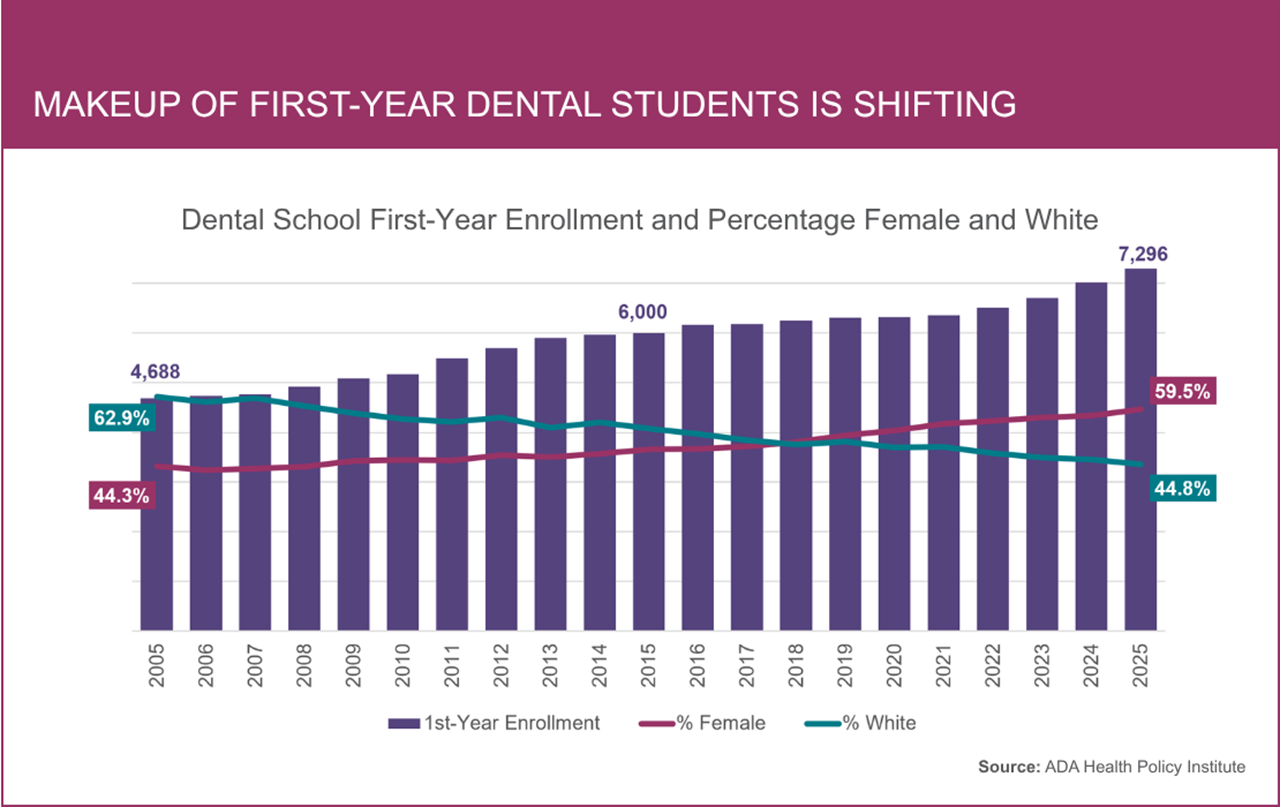
As spring graduations send new dentists into the workforce, we take a step back to look at who’s entering dental school and what those trends suggest for the future of oral health care. The dental education landscape has changed significantly over the last two decades. Since 2008, new dental schools have opened in the U.S. at an average of at least one per year, and first-year enrollment has increased by 56% since 2005. In 2025, the number of dental graduates topped 7,000 for the first time and could reach 8,000 before the end of the decade. Increased capacity within dental schools has allowed expanded entry into the profession. But, has it resolved demographic disparities, and does it guarantee increased access to oral care? The short answer for both is, "Yes" and “No.”
Over the last 20 years, the dental student population has become more diverse in terms of gender and race/ethnicity. In 2005, women comprised less than 45% of incoming dental students. In the fall of 2025, roughly 3 out of 5 incoming first-year dental students were female, the eighth consecutive year that women represented the majority of enrollees. Progress on gender equity, however, has not been accompanied by comparable gains in racial and ethnic representation.
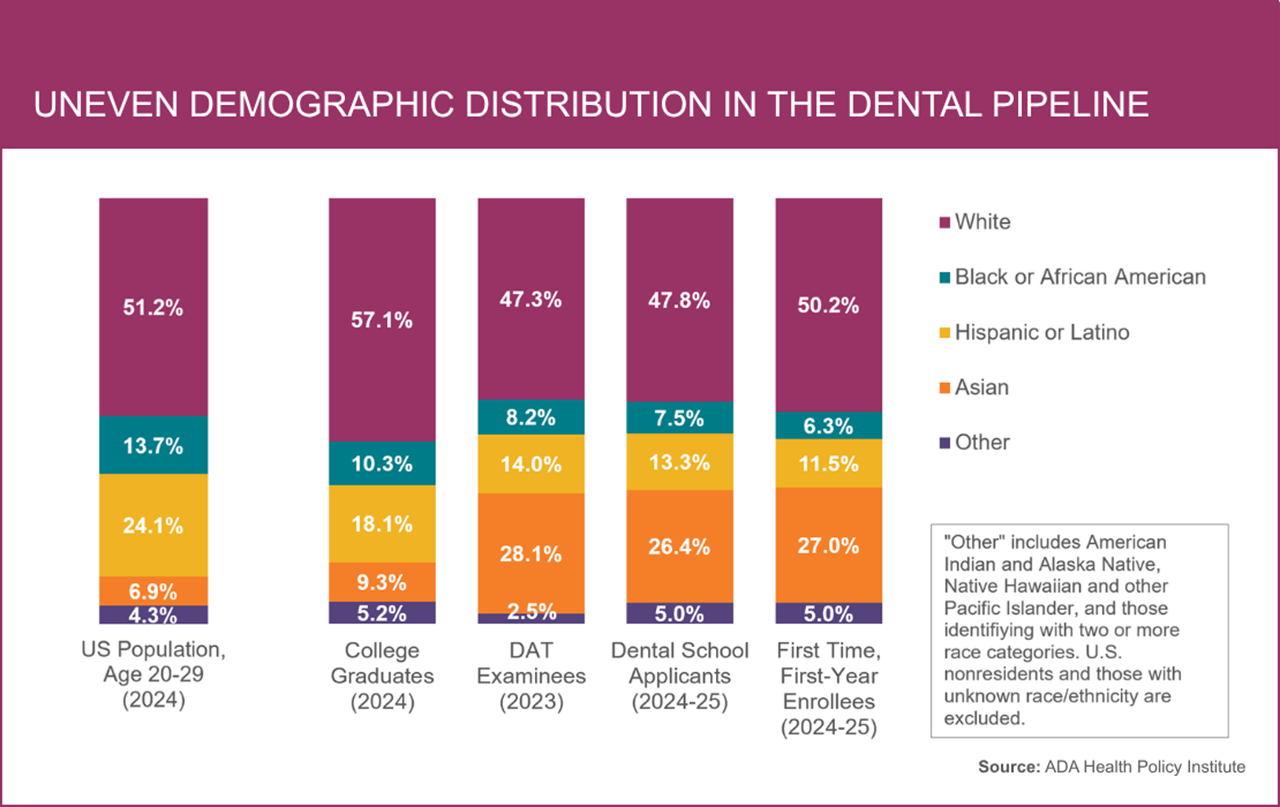
The proportion of non-white first-year dental students has risen overall during the last 20 years but still lags changes in the overall U.S. population.
HPI Perspectives
May 2026
Dental Student Demographics Have Changed. And Might Change Even More.
The change in the share of first-year dental students from historically underrepresented race/ethnicity (HURE)* groups has been uneven and modest. In fact, in 2025, the proportion of HURE students was only 1% higher than it was in 1987.
For Black dental students, consistent growth in dental school enrollment has been particularly evasive. Since the 1970s, Black students have ranged between 4 and 7 percent of first-year dental classes with no clear pattern or sustained growth. After reaching an all-time high of over 7% of the first-year dental school class as recently as 2021, Black enrollment has been declining since then and fell to under 6% in 2025. Although the percentage of U.S. undergraduate college students who are Black is about three-quarters of its share of the overall U.S. population, Black dental students are even more underrepresented, with a percentage of less than half of its share of the overall population (14% among 20–29-year-olds).
Since the late 1990s, the share of Hispanic first-year dental students has increased gradually, peaking at close to 11% in 2021 before falling to 10% in 2025. Yet this remains well below Hispanic representation among young adults and among college graduates: while Hispanics make up 24% of the U.S. population ages 20–29 and 18% of college graduates, they account for under 12% of dental students. In contrast to the rapid growth in Hispanic college graduates—nearly doubling over the past 12 years—dental school enrollment has not kept pace.
Asian students have made up at least 20% of first-year dental students for the past three decades, surpassing one-quarter of students in 2025. In comparison, their share of bachelor’s degree recipients rose more modestly and only increased from 7% to 9% over the last 12 years, and in 2024, were only slightly overrepresented relative to their share of the U.S. population. Asian first-year dental school enrollment is disproportionate to their share of both the U.S. population and college graduates overall, as they are overrepresented by a factor of 3 to 1.
The pattern of over and under-representation among race/ethnicity groups in dental school emerges not at the point of dental school admission, but much further upstream. The composition of dental admission test (DAT) takers shows a significant overrepresentation of Asian examinees and an underrepresentation of Black, Hispanic, and white examinees. For Black and Hispanic students, this disparity is often tied to well-documented structural barriers, including the high cost of applying to and preparing for the DAT and limited access to mentorship and professional networks.
For Black dental students, consistent growth in dental school enrollment has been particularly evasive. Since the 1970s, Black students have ranged between 4 and 7 percent of first-year dental classes with no clear pattern or sustained growth. After reaching an all-time high of over 7% of the first-year dental school class as recently as 2021, Black enrollment has been declining since then and fell to under 6% in 2025. Although the percentage of U.S. undergraduate college students who are Black is about three-quarters of its share of the overall U.S. population, Black dental students are even more underrepresented, with a percentage of less than half of its share of the overall population (14% among 20–29-year-olds).
Since the late 1990s, the share of Hispanic first-year dental students has increased gradually, peaking at close to 11% in 2021 before falling to 10% in 2025. Yet this remains well below Hispanic representation among young adults and among college graduates: while Hispanics make up 24% of the U.S. population ages 20–29 and 18% of college graduates, they account for under 12% of dental students. In contrast to the rapid growth in Hispanic college graduates—nearly doubling over the past 12 years—dental school enrollment has not kept pace.
Asian students have made up at least 20% of first-year dental students for the past three decades, surpassing one-quarter of students in 2025. In comparison, their share of bachelor’s degree recipients rose more modestly and only increased from 7% to 9% over the last 12 years, and in 2024, were only slightly overrepresented relative to their share of the U.S. population. Asian first-year dental school enrollment is disproportionate to their share of both the U.S. population and college graduates overall, as they are overrepresented by a factor of 3 to 1.
The pattern of over and under-representation among race/ethnicity groups in dental school emerges not at the point of dental school admission, but much further upstream. The composition of dental admission test (DAT) takers shows a significant overrepresentation of Asian examinees and an underrepresentation of Black, Hispanic, and white examinees. For Black and Hispanic students, this disparity is often tied to well-documented structural barriers, including the high cost of applying to and preparing for the DAT and limited access to mentorship and professional networks.
Why do demographic shifts among dental students matter? As today’s students become tomorrow’s providers, not all providers practice in the same places or treat the same patients. In 2024, the CDC estimated that 57 million Americans live in dental shortage areas, with about two-thirds of those in rural communities. Despite steady increases in dental school enrollment, little progress has been made in narrowing the gap between the supply of dentists in urban and rural areas. In fact, this gap has continued to widen over the past two decades. As younger dentists gravitate to practices in urban settings, this pattern is likely to persist. Non-white dentists and female dentists, all else equal, are more likely to treat Medicaid patients and work in communities with limited access to care. Yet the overall share of dentist workforce who are Medicaid providers has remained largely unchanged in recent years.
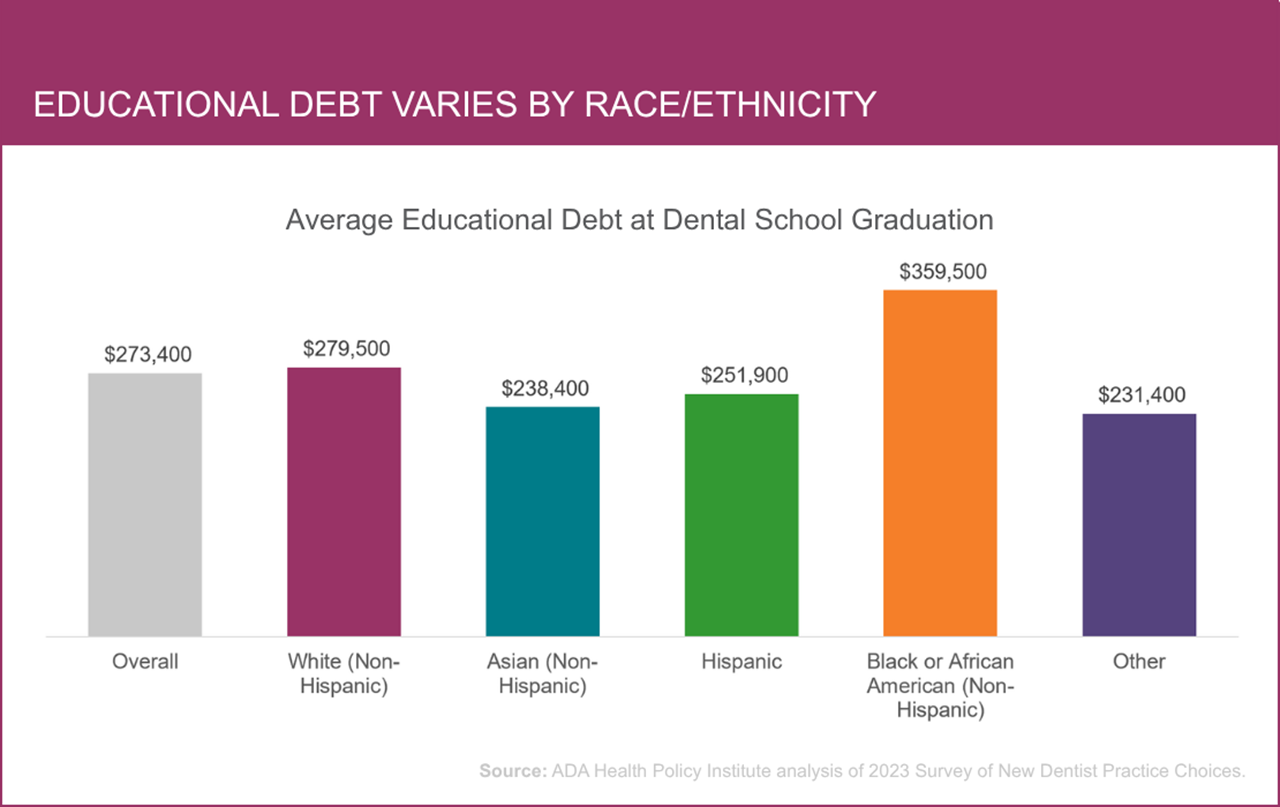
Looking ahead further, the recent cap on federal student loans to $50,000 per year for dental school raises additional concerns. We will dig into this in a future Perspectives piece, but the bottom line is that these borrowing limits are sure to constrain the applicant pool to dental schools. The average first-year tuition and related costs at U.S. dental schools in 2025-26 were over $80,000. Student debt burdens are already disproportionately high among Black students who are more likely to rely on federal loans to finance their education.
These borrowing constraints have the potential to threaten the already uneven growth of HURE students in the dental workforce pipeline, which, we argue, could have serious oral health implications. In that sense, the composition of today’s dental student body is not simply about representation; it is about expanding access to care and building the future of oral health equity.
Looking ahead further, the recent cap on federal student loans to $50,000 per year for dental school raises additional concerns. We will dig into this in a future Perspectives piece, but the bottom line is that these borrowing limits are sure to constrain the applicant pool to dental schools. The average first-year tuition and related costs at U.S. dental schools in 2025-26 were over $80,000. Student debt burdens are already disproportionately high among Black students who are more likely to rely on federal loans to finance their education.
These borrowing constraints have the potential to threaten the already uneven growth of HURE students in the dental workforce pipeline, which, we argue, could have serious oral health implications. In that sense, the composition of today’s dental student body is not simply about representation; it is about expanding access to care and building the future of oral health equity.
* Historically underrepresented race/ethnicity (HURE) groups includes Black or African American, Hispanic or Latino, American Indian/Alaska Native, and Native Hawaiian or other Pacific Islander.