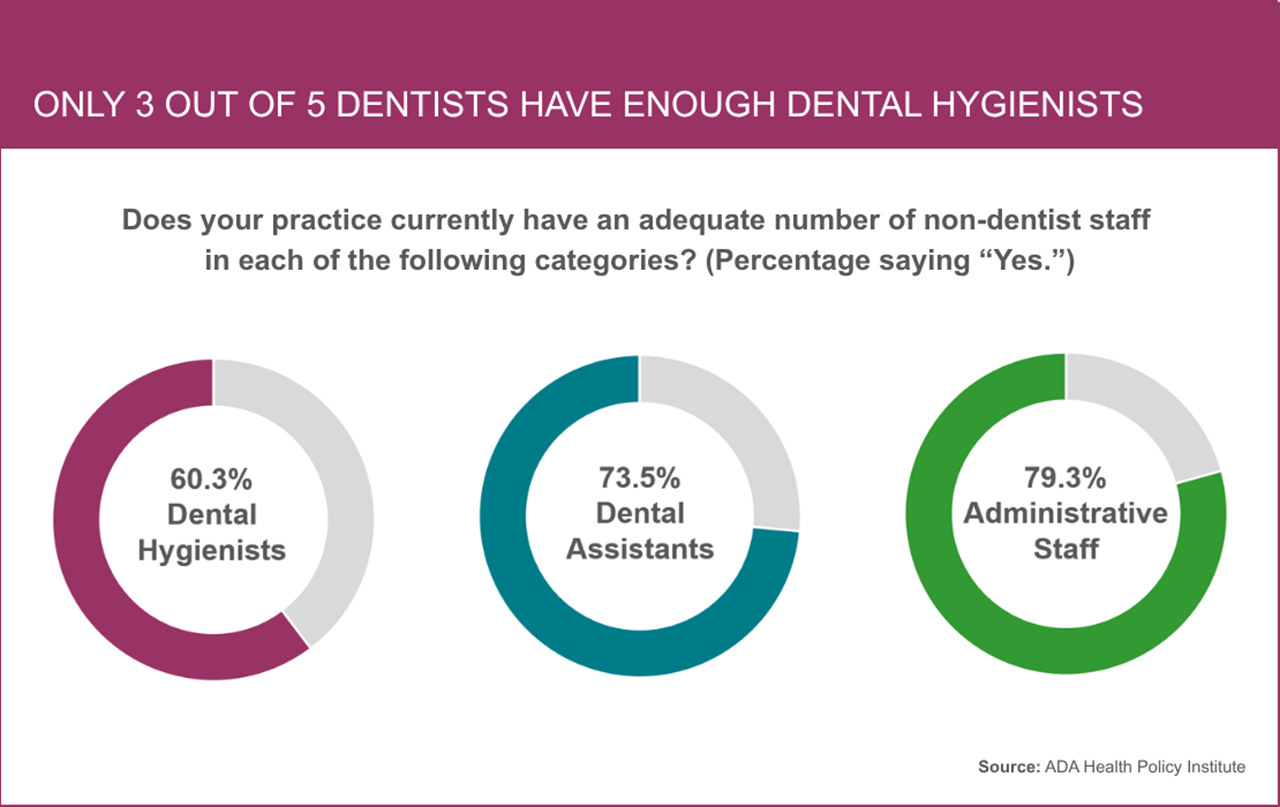
We have a major dental hygienist shortage in the U.S. According to the latest data from the ADA Health Policy Institute (HPI), only 60% of dentists have an adequate number of dental hygienists on staff. For dental assistants and administrative staff, the situation is a bit less dire, with higher shares of dentists reporting adequacy. Among dentists who were actively recruiting or had recently recruited a dental hygienist, 91% said it was very or extremely challenging.
Staffing shortages were also top of mind when dentists were asked about their biggest challenges looking ahead to 2026. In fact, staffing issues came in tied for the top spot alongside dental insurance issues.
HPI Perspectives
April 2026
We Have a Major Dental Hygienist Shortage. It's Unlikely to Go Away Soon.
Digging a bit deeper, the data uncover important insights on the true nature of the dental hygienist shortage. It is, indeed, a simple issue of supply and demand. Dentists cannot find candidates for vacant positions willing to work at going wages and for the required number of hours. HPI has analyzed the data, but picking out some of the most frequent comments is more insightful and interesting. Many dentists say things like…
_________________________________________________________________________________
“The hygienists that temp have no interest in working full time.”
“There are not enough [hygienists] and the wages they are asking for are over reimbursement rates.”
"Very few unemployed dental hygienists in this area. No new graduates."
“There are none, and all my colleagues also have ads out for hygienists.”
_________________________________________________________________________________
How is the labor market responding in the face of such acute shortages for dental hygienists? First, let’s look at training programs. With so much excess demand for dental hygienists, has the pipeline expanded? Yes. First-year enrollment in hygiene programs increased by 16% from 2020 to 2025, and graduate numbers have been increasing since 2022. In fact, the U.S. saw the highest number of graduates from dental hygiene programs ever in 2025. But without knowing retirement numbers, it’s difficult to assess how much impact expanded enrollment is having on total employment. Given that the total number of staff working in dental offices in the U.S. has been stubbornly flat for at least a year and a half, it seems more enrollment is not leading to an expanded labor pool. But without a good source of data for retirements or exits from the labor market, it is difficult to give a definitive answer.
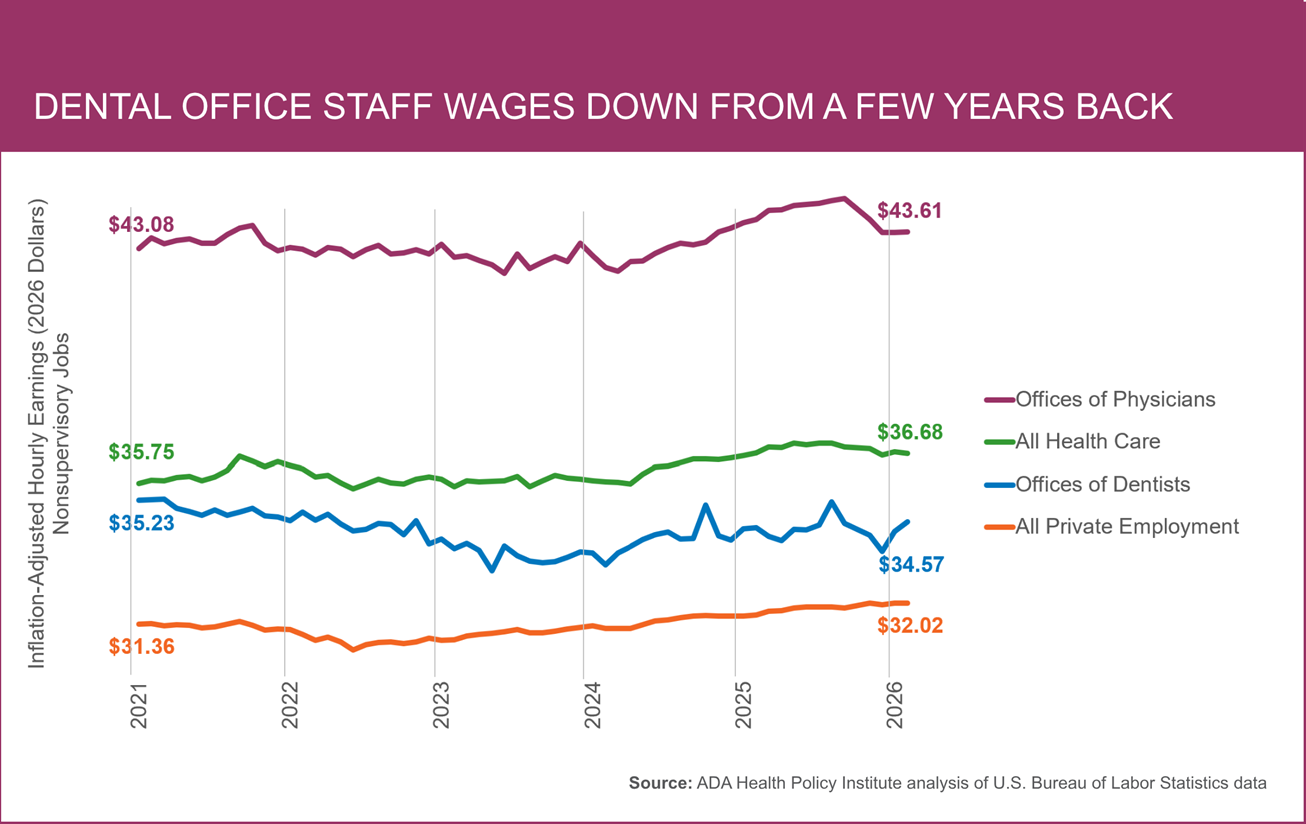
Second, let’s look at wages. Have wages increased in response to the dental hygienist shortage? No. The latest data show that after adjusting for inflation, the average wage for dental office staff in the U.S., including dental hygienists, is actually down from a few years ago. In comparison, wages for staff working in medical offices have increased slightly while the average wage for all private workers in the U.S. – the broadest measure – has increased steadily. This is an important conclusion. Jobs in dental offices are becoming relatively less attractive from a purely wages perspective compared to jobs in the rest of the health care system and the U.S. economy overall.
So why aren’t wages rising significantly for dental hygienists, dental assistants, and administrative staff? A look at the economic performance of dental offices as reported by dentists offers a hint. Revenues are down as practice expenses are up. Government data affirm what these dentists are saying. Prices for some of the biggest cost drivers in dental offices – equipment, supplies, technology – are rising at a faster rate than reimbursement for dental care services. Trends of rising prices and stagnant reimbursement rates generate margin compression – what we have dubbed the “fiscal squeeze” on dental practices – and make it difficult for dental practice owners to increase staff wages.
Logically, then, how the dental hygienist shortage evolves will be closely tied to how the fiscal squeeze evolves. Is there something on the horizon that could significantly alter reimbursement trends for dental care services? How about something that could significantly reduce costs on the practice expenses side of the ledger? Are there technologies that could dramatically improve efficiency that might be more widely adopted? In response to margin compression, will practice models adjust to somehow compensate with expanded scale and volume? Can the cost of training, or the length of training for dental hygienists and assistants be reduced through reforms like smaller faculty-to-student ratios or increased investments to expand capacity of training programs? Could scope of practice for dental hygienists be expanded to include services with higher economic return on investment for dental practices, which changes the nature of the wage increase discussion? Could scope of practice be expanded for dental assistants to compensate for the difficulty in finding dental hygienists?
There are some indications of movements in these areas. For example, some states are exploring expanded services performed by dental assistants. Missouri recently introduced a pilot program where dental assistants received training to perform expanded functions including supragingival scaling patients diagnosed as periodontally healthy or with gingivitis. Other states are allowing foreign-trained dentists to practice as dental hygienists, including Florida, Connecticut, Vermont, and Massachusetts, while Indiana and Virginia both passed bills that will take effect in summer 2026.
HPI will continue monitoring the staffing situation in dental practices. If no major movement occurs in the areas of reform discussed above, then it is conceivable for current staffing shortages to persist into the near future. Time will tell.
Logically, then, how the dental hygienist shortage evolves will be closely tied to how the fiscal squeeze evolves. Is there something on the horizon that could significantly alter reimbursement trends for dental care services? How about something that could significantly reduce costs on the practice expenses side of the ledger? Are there technologies that could dramatically improve efficiency that might be more widely adopted? In response to margin compression, will practice models adjust to somehow compensate with expanded scale and volume? Can the cost of training, or the length of training for dental hygienists and assistants be reduced through reforms like smaller faculty-to-student ratios or increased investments to expand capacity of training programs? Could scope of practice for dental hygienists be expanded to include services with higher economic return on investment for dental practices, which changes the nature of the wage increase discussion? Could scope of practice be expanded for dental assistants to compensate for the difficulty in finding dental hygienists?
There are some indications of movements in these areas. For example, some states are exploring expanded services performed by dental assistants. Missouri recently introduced a pilot program where dental assistants received training to perform expanded functions including supragingival scaling patients diagnosed as periodontally healthy or with gingivitis. Other states are allowing foreign-trained dentists to practice as dental hygienists, including Florida, Connecticut, Vermont, and Massachusetts, while Indiana and Virginia both passed bills that will take effect in summer 2026.
HPI will continue monitoring the staffing situation in dental practices. If no major movement occurs in the areas of reform discussed above, then it is conceivable for current staffing shortages to persist into the near future. Time will tell.