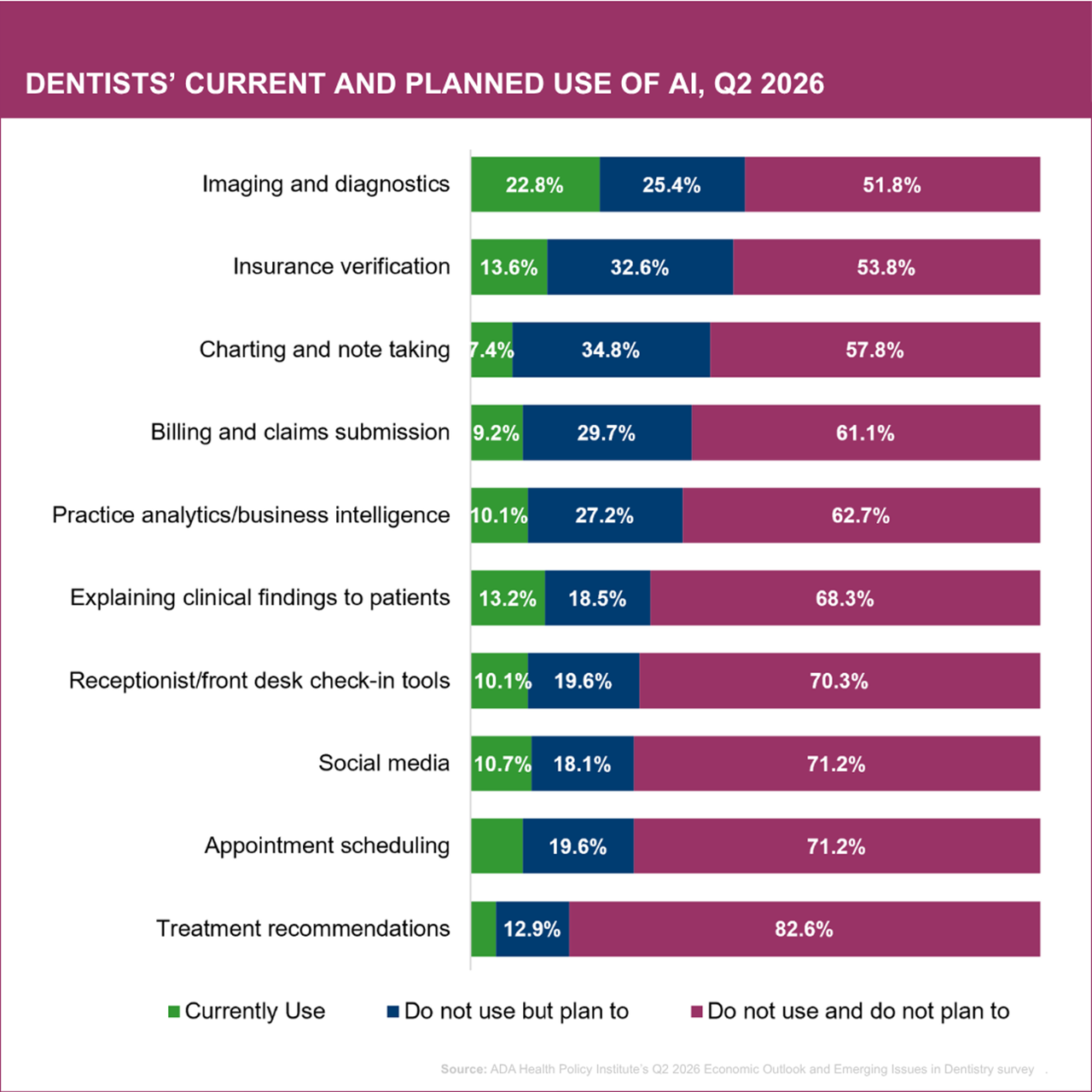
Given that dentists show the most interest in adopting AI technologies to assist with charting and notetaking, insurance issues, and billing, the biggest opportunities in the near term seem focused on easing administrative burdens, a pain point for dentists and health care practitioners in general. Dental practices are struggling with ongoing staffing shortages, and dentists are spending more of their work week on non-clinical tasks. Around one-third (32.4%) of dentists report being overworked. Workload and practice efficiency issues are persisting in the current labor market, and some dentists may view AI tools as a workaround to ongoing staffing problems.
On the clinical side, however, dentists are skeptical about AI’s potential and appropriateness. Dentists are less likely to use AI for high-level clinical tasks: four out of five (82.6%) do not plan to use AI for treatment recommendations and two-thirds (68.3%) do not plan to use it to explain clinical findings to patients. There is a clear dividing line, so to speak, where dentists seem open to AI. The hesitancy is driven in part by dentists’ fears of AI replacing human judgment and the potential for errors leading to overtreatment and misdiagnoses among dental patients. Here are some typical examples of what dentists had to say:
________________________________________________________________________________
“It would be a helpful adjunct, but I would have concerns that some dentists would rely on AI more than utilizing their own diagnostic skills.”
“It has its place but still must be monitored and verified by humans.”
“AI for business management could be helpful...Using it in place of thorough clinical training and strategic expertise of the doctor will not be good for the patient at this time. Prompts and close monitoring, along with the human eye, are still key for patient care.”
“It certainly is in its early stages, but I want to get more informed about it before incorporating into my practice. I certainly believe that it will be a popular and useful feature looking ahead to the future.”
“Radiographic and caries detection helps a little, but x-rays still need to be reviewed without it anyway, as it makes mistakes.”
“I've tried it with x-ray reading and it was about 30% accurate. It needs more time.”
________________________________________________________________________________
One important step toward building trust in clinical use of AI tools is the development of standardized AI model fact labels that clearly communicate key information about an AI system, including its intended use, training data, validation methods, performance characteristics, limitations, and appropriate clinical context. By promoting greater transparency, these fact labels can help dentists make more informed decisions about whether and how to incorporate AI into patient care. Recognizing this need, the ADA Standards Program is developing a standard for AI model fact labels in dentistry to support consistent reporting, foster confidence in the responsible use of AI, and facilitate informed adoption of AI technologies in dentistry. ADA subject matter experts and advocacy teams are closely watching federal and state-level conversations around regulations on AI use for both clinical and non-clinical purposes.
“AI and Technology” will also be one of the pillars of the ADA’s Oral Health 2050, a strategic initiative aimed at establishing a roadmap for dentistry’s next quarter of a century. A panel with ten experts from across the dental industry will be meeting over the next few months to establish the vision for the use of AI and emerging technologies within the profession.
Looking ahead, it is clear that AI has taken a strong foothold in the dental sector. Other published research finds even larger take-up rates for AI in dentistry than our survey findings. There is an openness to expanded AI use, but there also appears to be a healthy degree of skepticism among dentists as to potential pitfalls, particularly in applications related to clinical decision making. The success of AI in the dental care sector will depend on the ability of AI technology to address these concerns.